
Handwriting Slant Meaning: Right, Left, Upright and Variable
Explore handwriting slant meaning, measure right or left lean, and compare traditional readings with a real analyzer run on Lincoln’s handwriting.
By William ZZ, Founder · Published 2026-11-11
Handwriting slant is the direction the tall downstrokes lean: right, upright, left, or a mix that changes along the line (variable). Graphologists traditionally read right slant as outgoing or expressive, upright as controlled, left as reserved and variable as changeable; these readings come from a tradition, not a validated psychological test.
Want a reading of your own page? Upload a photo to the Handwriting Analyzer and compare it with the guide below.
What handwriting slant is and how to measure it
Slant is the angle of the downstrokes against a vertical line. The steps below are for Latin-script handwriting such as English. Look at tall letters such as l, h, b, d, k and t, where the long stems make the lean easier to see; ignore decorative loops and crossbars.
For a simple paper check, draw lines along the main downstrokes of 10 or more tall letters across several lines of writing. Compare those marks with a vertical reference perpendicular to the writing’s baseline. Look for the overall pattern, rather than letting one unusual letter decide the result. A rising line of text is a baseline feature, separate from slant.
School styles differ. Wikipedia’s copybook table lists Spencerian at 52°, Copperplate at 55°, Palmer Method and D’Nealian at 85°, and Carolingian at 90°. Those angles are measured counterclockwise from the baseline: under 90° means right slant, 90° means upright, and over 90° means left slant. State which reference you use before comparing numbers.
Right, upright, left and variable slant: traditional readings
Right slant
The tops of the stems lean to the right of their bases. Graphologists traditionally link this forward lean with expressiveness, warmth and reaching toward others. It is a symbolic association; a right lean does not establish how outgoing someone actually is.
Upright (vertical) slant
The main downstrokes stand close to perpendicular to the baseline. Graphologists traditionally link upright writing with restraint, balance and measured expression. A school-taught print style can produce the same appearance without saying anything about the writer’s temperament.
Left slant
The tops of the stems lean left of their bases. Graphologists traditionally link this backward lean with reserve, privacy or holding back expression. Read the shape neutrally: it is a writing pattern, and it does not make someone unfriendly.
Variable slant
The lean changes between letters, words or lines, sometimes moving across vertical. Graphologists traditionally link variable slant with responsiveness or changing expression. First check whether the variation is widespread: a curved letter beside a straight stem can create a misleading impression of change.
Extreme slant (very far right or left)
The stems lean conspicuously far from vertical in either direction. Graphologists traditionally link an extreme right lean with heightened expressiveness and an extreme left lean with stronger reserve. There is no personality threshold hidden in a particular angle; an intentionally decorative script can look just as dramatic.
Slant | What you see | Traditional reading | Common non-personality causes |
|---|---|---|---|
Right | Stems lean right | Expressiveness, warmth | Copybook style, page angle |
Upright | Nearly vertical stems | Control, balance | Print instruction, deliberate lettering |
Left | Stems lean left | Reserve, privacy | Left-handed technique, posture |
Variable | Lean changes | Responsiveness | Speed changes, shifting paper |
Extreme | Strong lean either way | Emphasized expression or reserve | Calligraphy, unusual writing surface |
Things that change slant besides personality
Copybook habits can persist long after school. Handedness also matters: Wikipedia notes that left-handed writing often leans backward past 90°. That is not a rule for every left-handed writer.
Writing speed, pen and paper, posture, and page angle can all change how strokes land. Writing on a wall or whiteboard changes the movement again because the arm works on a vertical surface. Compare everyday samples under similar conditions before treating a change in lean as meaningful.
A real run: Lincoln's Gettysburg Address manuscript (Bliss copy)
The Bliss copy is one of five known manuscript copies of the Gettysburg Address in Lincoln’s hand. It was written in 1864 for Alexander Bliss; Wikipedia’s manuscript account describes the copies and their history.
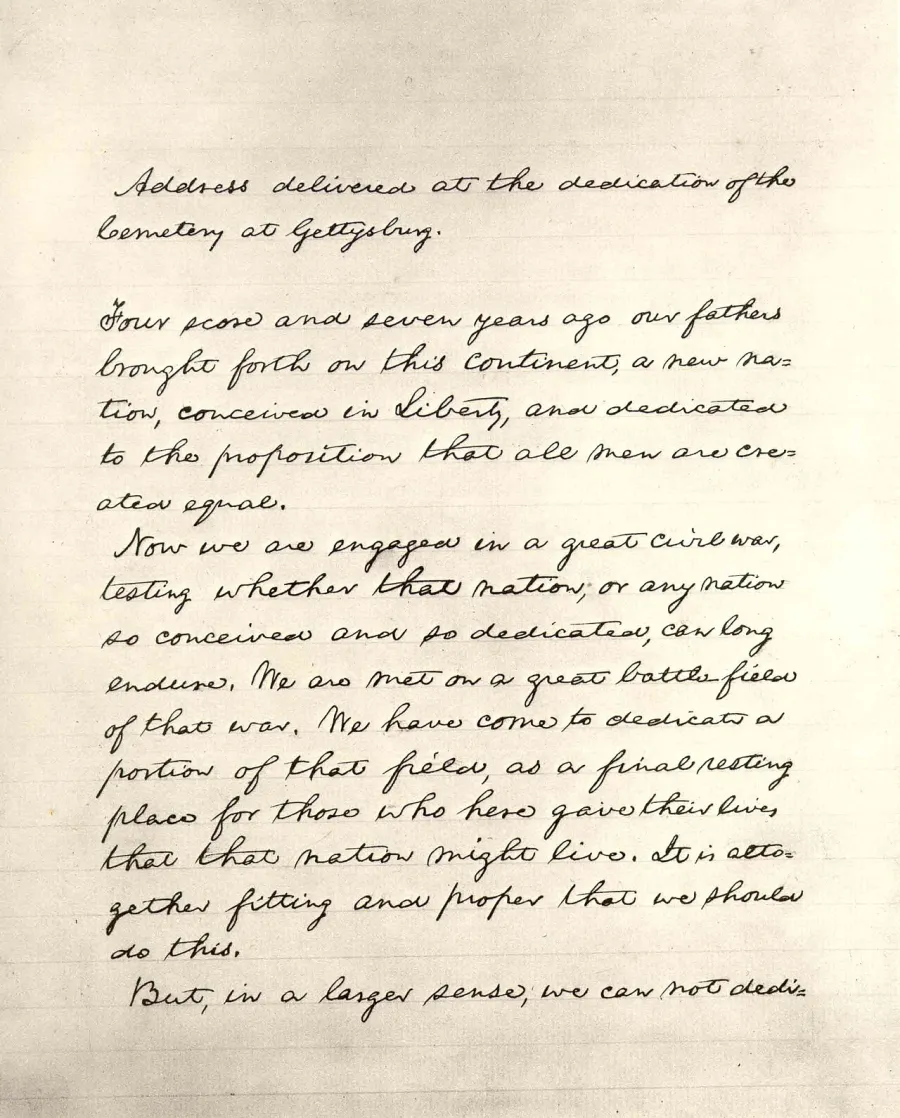
Bliss copy, page 1, public domain, via Wikimedia Commons.

- Input: 1280 × 1590 px JPEG of page 1 (Wikimedia 1280 px rendition).
- Run date: 11 November 2026.
- Time taken: 29.6 s, measured from request start to response for this single local run (not a speed benchmark).
- Mode: handwriting.
We ran the site’s analysis code from commit 7c168f6 locally, using the same prompt, vision models and safety checks as the live tool, because the per-IP daily limit the site had at the time was already used. (The site now uses account credits instead.)
Slant observation (unedited):
Letters show a consistent, pronounced rightward slant, with some variation in individual strokes.
Slant reading (unedited):
In traditional graphology, a rightward slant is often associated with expressiveness, warmth and an outward-oriented approach to interaction. Some graphologists read it as emotional engagement.
Legibility value (unedited):
high
First sentence of the summary (unedited):
Through the lens of traditional graphology, this handwriting may suggest an expressive, engaged and determined personality style.
The full output returned observations and readings for 8 features, and the full JSON is kept with this guide’s source evidence. Those traits cover slant, size, pressure, spacing, baseline, margins, letter forms and connections.
By eye, this page shows a strong right lean consistent across lines, matching the tool’s description while allowing for individual strokes. This is a visual comparison, not a measured angle. The tool reads the whole page, not just slant, so its summary also reflects other features. Its traditional reading is not evidence about Lincoln’s personality.
Limits of reading personality from slant
Graphology is not a validated psychological test. Recognizing a visible lean and assigning personality to it are different tasks. A clear photo can help the analyzer describe shapes, but it cannot turn traditional associations into established personality findings. Use the reading as a reflection prompt.
Check your own handwriting slant
Write five or more lines on plain paper at your natural speed. Photograph the page from directly above in even light, keeping the stems sharp and the page flat. Avoid shadows, tilted camera angles and deliberately changing your usual style.
Try the Handwriting Analyzer for everyday writing. For a signed name, use the Signature Analyzer, which looks at signature-specific features such as capitals and flourishes.
Handwriting slant FAQ
What does it mean if your handwriting slants to the right?
It means the main stems lean right. Graphologists traditionally associate that shape with outgoing or expressive tendencies, but writing instruction and page position can produce it too.
Is left-slanted handwriting bad?
No. Left slant is a normal writing variation. Its traditional association with reserve is not a judgment, and handedness or writing technique may explain the shape.
Why does my handwriting slant change?
Speed, posture, paper angle and writing surface can change the lean. Compare several lines in similar conditions before calling the slant variable.
Can you change your handwriting slant?
Yes, you can practice a different angle with guidelines and repeated tall letters. Changing the shapes is a handwriting exercise; it does not demonstrate a change in personality.